 |
 Waiting for Spring by Ottawa Fiber is licensed under a Creative Commons Attribution 3.0 Unported License. |

Make yourself a cup of tea and come join me in my fiber adventures...
Sunday, March 10, 2013
Waiting for spring
Great picture of the cat yesterday, cropped and converted to black and white. Pumpkin so wants to be an outside cat, but we lost our last outside cat and so have proclaimed that all cats will now be indoor cats. But she can still dream, and watch the chickadees feed in the lilac tree.


Saturday, March 9, 2013
Dehairing Alpaca Fiber
I got some beautiful Alpaca fiber on the Internet a month or two ago. Of course, when you are buying form a new seller, you don't always know what you are going to get! The fleece was lovely, but it did contain a lot of guard hairs.
Sooo...For this week's manual therapy (aka keeping my arthritic fingers mobile!), I dehaired almost a pound of raw Alpaca. It was incredibly relaxing and I find that I really connect with my fiber when I take the time to process it carefully. Some was dyed, some was undyed, all was pre-washed. Next time I may see about dehairing before I wash the fiber.
He's a videoblog post about it (and some random ramblings as well!) And as an added bonus for those of you who visit the blog, here are a bunch of pictures showing some close ups of alpaca fiber vs. guard hair.
Sooo...For this week's manual therapy (aka keeping my arthritic fingers mobile!), I dehaired almost a pound of raw Alpaca. It was incredibly relaxing and I find that I really connect with my fiber when I take the time to process it carefully. Some was dyed, some was undyed, all was pre-washed. Next time I may see about dehairing before I wash the fiber.
He's a videoblog post about it (and some random ramblings as well!) And as an added bonus for those of you who visit the blog, here are a bunch of pictures showing some close ups of alpaca fiber vs. guard hair.
 |
| Alpaca before dehairing |
 |
| Alpaca after dehairing |
 |
| Alpaca fiber on the left, Guard hair on the right |
 |
| Finger twisted guard hair - adding this to another fiber would make some very strong yarn/cord |
Friday, February 8, 2013
It's a girl!
I have an exciting announcement. There's a new member in my family.
Well...sort of. I've sponsored a sheep named Coco for the year. I'm pretty happy about this. In another life I'd have a flock of sheep. But for various reasons, I don't, and so I need to find another way to get my shepherdess fix.
I found a farm in the US that lets you sponsor a sheep for the year. Solace Farm in Washington has registered Finn sheep, Boar Goats and Border Leicester sheep. I chose them because I saw a cute sheep named Coco on their site and the Finn sheep represent my Finnish heritage. According to them, she is a RUSKEA color, which in Finnish RUSKEA is pronounced roosk-e-a (the a is a short vowel sound.
I really like the idea of sponsoring a sheep for a year. I give the farm money that contributes to my sponsored sheep's upkeep, and I get to follow her year with pictures and letters, and of course, the fleece from her Spring shearing.
For me, this sponsorship represents a contribution toward the farmers who make sure that we have a wide variety of breeds to choose from. It allows them to focus on caring for their animals while sharing some of the joy and excitement of following a specific sheep over the course of the year.
If you would like to sponsor your own sheep, you can contact Sandra and Robert from their website here (contact us is on the right hand side!). They are really friendly and will answer any questions you may have!
Well...sort of. I've sponsored a sheep named Coco for the year. I'm pretty happy about this. In another life I'd have a flock of sheep. But for various reasons, I don't, and so I need to find another way to get my shepherdess fix.
I found a farm in the US that lets you sponsor a sheep for the year. Solace Farm in Washington has registered Finn sheep, Boar Goats and Border Leicester sheep. I chose them because I saw a cute sheep named Coco on their site and the Finn sheep represent my Finnish heritage. According to them, she is a RUSKEA color, which in Finnish RUSKEA is pronounced roosk-e-a (the a is a short vowel sound.
 |
| Coco from Solace Farm |
For me, this sponsorship represents a contribution toward the farmers who make sure that we have a wide variety of breeds to choose from. It allows them to focus on caring for their animals while sharing some of the joy and excitement of following a specific sheep over the course of the year.
If you would like to sponsor your own sheep, you can contact Sandra and Robert from their website here (contact us is on the right hand side!). They are really friendly and will answer any questions you may have!
Thursday, April 1, 2010
April '10 Canadian Fibre Box
So here it is, the last official monthly Canadian Fibre Box. What a riot these past 9 months have been. Thanks for being part of the Canadian Fibre Box! This month, we have an amazing indie dyer from out West, and another from close to me here in Gatineau (just across the Ottawa river). Both can be found on Etsy. Finally there is a sample of superwash BFL from a Canadian mill...we almost always think of merino for superwash, but who wouldn't want to be able to wash up a BFL project? If you like it, more can be ordered from OVFA.Rocky Mountain Dyeworks
written by Hasmi Ferguson

About the Dye Artist
I am a fibre artist who started by making my own dowry! Born to immigrant parents who still believed in the old ways, I was encouraged from a young age to learn all “women’s work” and to create enough product to show off my skills as marriageable material. Although I argued I would only marry for love (and I finally did!) I didn’t give up working on my dowry. I learned to sew, knit, crochet (badly), cross stitch, do beadwork, quilt, etc. By the time I decided I’d rather buy my dowry, I was hooked on textile crafts. After trying many different textile genres and techniques, I found that my passion was creating colour. I have been dyeing since 2005 and selling my hand-dyed products since 2007. I have been a member of The Textile Museum since moving to Toronto to go to university, which was some time in the mid-80’s. -
You can visit Rocky Mountain Dyeworks on Etsy, here. The main site is still under construction, but you can find it here. I'm thrilled that we were able to sneak Hasmi in before the monthly boxes stopped!
Turtlepurl Yarns
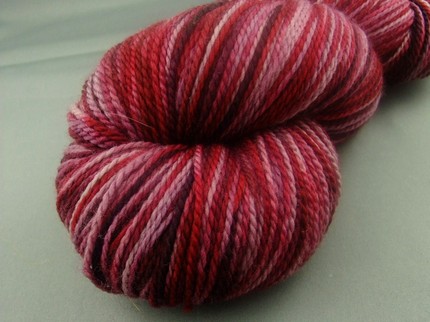 Genevieve
is local to my area and has a great eye for colour. She's also the creator
of Charteze, which are portable magnet strips that will keep your place on a
chart while you knit, crochet or cross-stitch. Her sock and lace yarns are
in high demand, and she has an awesome range of colours. You can find her on
Etsy, here.
Genevieve
is local to my area and has a great eye for colour. She's also the creator
of Charteze, which are portable magnet strips that will keep your place on a
chart while you knit, crochet or cross-stitch. Her sock and lace yarns are
in high demand, and she has an awesome range of colours. You can find her on
Etsy, here.Share your projects
Come
join us on Ravelry at the Ottawa
Valley Fiber Arts group, to share your projects and ideas! If you
haven't joined Ravelry yet, it's free and an amazing resource for fibre
fanatics.
Subscribe to:
Posts (Atom)